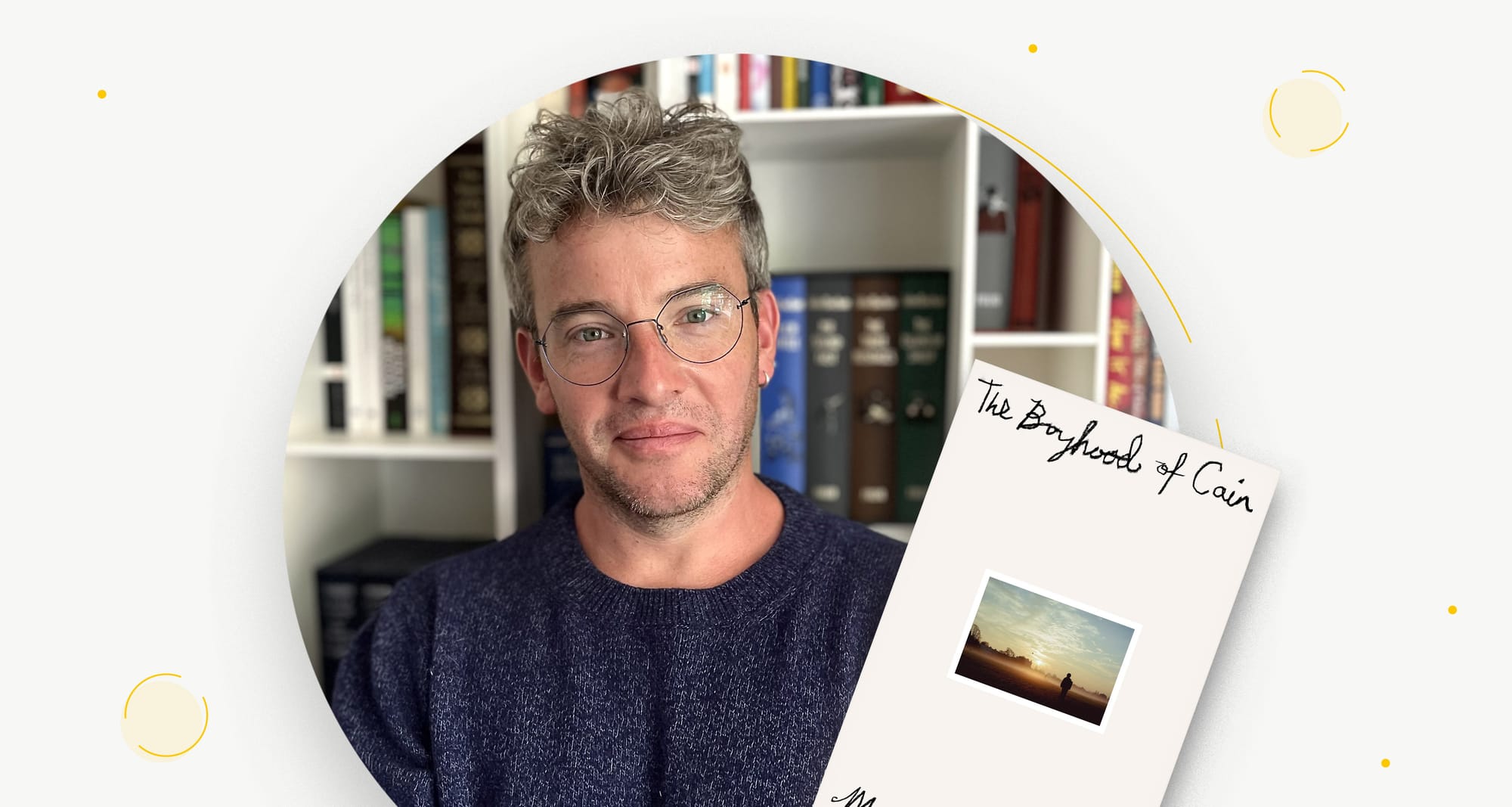
Michael Amherst is a British writer and critic. His debut novel, The Boyhood of Cain, was released by Faber & Faber (UK) and Riverhead Books (US) in 2025, and named one of the best books of the year by The New Yorker. Amherst’s writing has appeared in The Guardian, New Statesman, The White Review, and others.
Every writer has an origin story. Could you share yours? How did you first come to writing? And, eventually, what led you to pursue writing as a career?
I’m afraid I was one of those children who wanted to be a writer as soon as I discovered books. But it wasn’t a straightforward journey: I stopped reading for a while in my early teens and having written assiduously in my early years I stopped for a very long time—perhaps until university. I think I found writing a way to deal with loneliness, or a sense of being alone. I often write as a result of some nagging preoccupation that won’t leave me alone, something I want to make sense of. I had hoped to go into academia—I loved being an English undergraduate—but I found that my mind wasn’t made for it. I couldn’t keep to one thing, couldn’t think in the right way. Which is another way of saying, I’m not rigorous enough to be an academic. But I hope there are other ways of looking at and answering questions.
Your first novel, The Boyhood of Cain, is set in the English countryside and follows Daniel, a young boy coming of age while grappling with newfound questions of selfhood, belonging, love, and injustice. What inspired this story, and what compelled you to be the one to tell it?
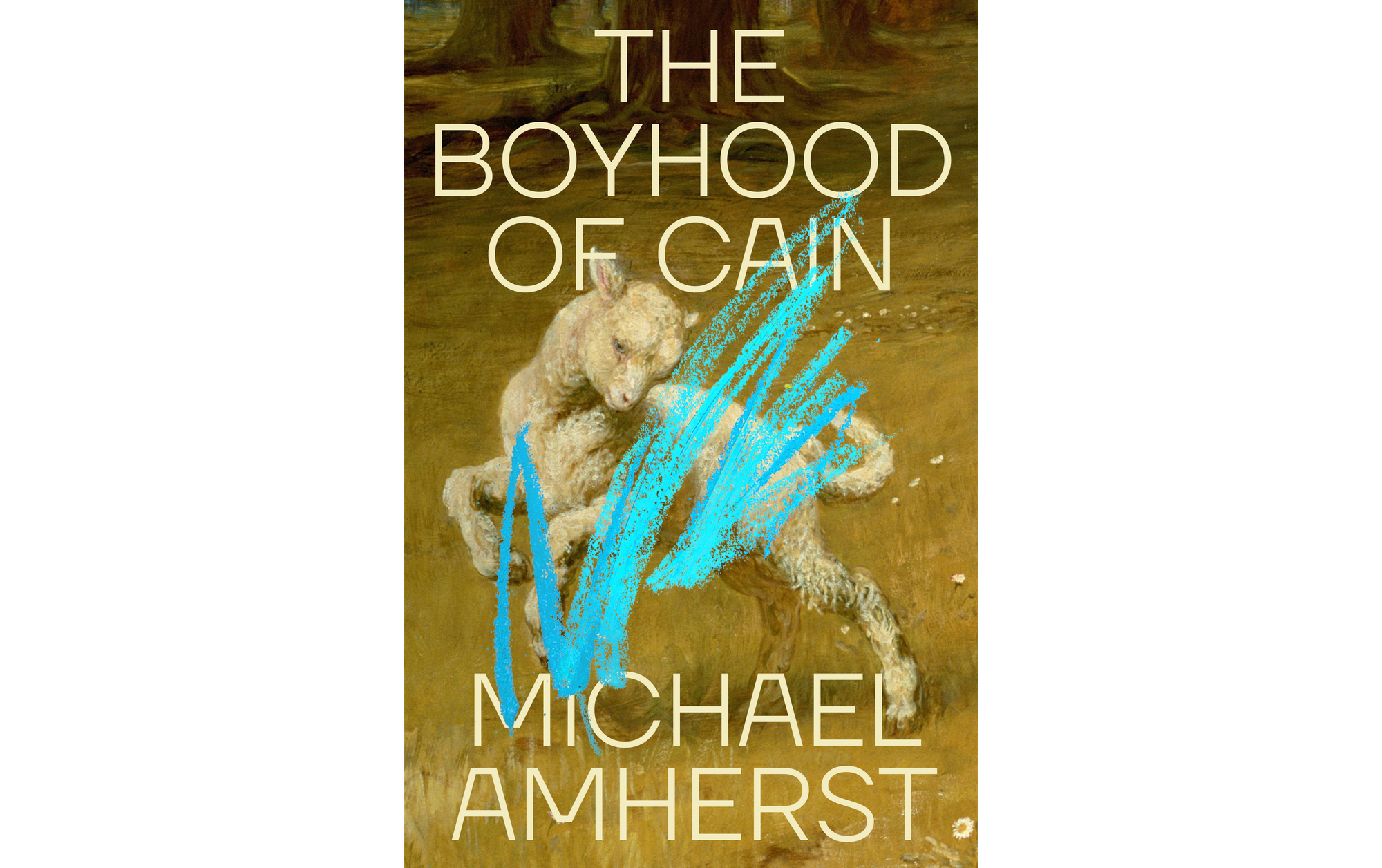
Several things. I’d already written a bad first novel, in which I tried to explore that boundary between jealousy and desire—that desire to be someone else and that desire for someone else. I think particularly in relation to a sense of lack, of not being sufficient in a way that others are. And then I wrote this scene, with two boys on a beach, a version of which comes at the end of the novel. But at first they were the same age and I just kept having this image, this scene of two boys, sussing each other out. And a hunger in one of them. And later, I wrote the scene in which Daniel asks his mother if he could be Jesus, and I gave him a voice.
You have to have the arrogance—or maybe faith—that what you’re doing is important and will count for something.
Coming-of-age stories carry a timeless quality and have been told and retold throughout history. Was your novel influenced by any other literary works? And, as a first-time author, how was the path to finding your own voice?
So many! J.M. Coetzee’s Jesus trilogy and autobiographical fictions. Steinbeck’s East of Eden. I suspect many of the children’s adventure novels I read growing up. I think, to be honest, I struggled to find my own voice. I recognise something uncertain and circuitous in everything I write. I know—now!—that my sentences always repeat and refine, which is perhaps another way of saying qualify. Like that! So I suppose I accepted that as part of my voice. But in this instance, Danny’s voice eventually came very clear and distinct and from that moment on, I had him. I’m working on something else now and, again, there are moments where I feel these characters’ voices coming through. It’s early days, but I want to latch onto that.
How have your own experiences shaped your writing? Is that influence something you’re after, or something you’d rather keep at a distance?
I don’t think one can help being shaped by experience. Even if I denied it or ran away from it, I know it would get in somewhere. That being said, I think that the best writing—the best of my writing—comes from when experience is transformed somehow into something new, something I don’t expect. I don’t know what happens there, whether it is my unconscious or what, but to have the faith to trust in that part of your creativity is hard, but necessary.
I can’t help feeling there’s a terrible presumption in believing you ‘know’ everything that is to come.
Working on a novel can often be a long, laborious task spanning years. Did you begin with a clear idea of the story, or uncover it as you were writing?
Very much the latter. The writers I admire are those who describe writing to find what they mean, or only discover their story in the process of writing. If I have a process, it is hopelessly disjointed and open-ended: I have to see what emerges, and that means many wasted days and wasted pages…or I say wasted, but I think that is how you find your way. In that sense, nothing is wasted. I know I struggle to write with a clear plan. I have tried but I get bored. There’s nothing to find out then. And I can’t help feeling there’s a terrible presumption in believing you ‘know’ everything that is to come. Flannery O’Connor said she only knew the bible salesman would steal Hulga’s wooden leg in her story ‘Good Country People’ the page before it happened. I stick to that!
Looking back, what would you say was your greatest challenge in writing The Boyhood of Cain?
Perhaps keeping going!? I think you have to be a combination of deeply arrogant and deeply self-doubting to be a writer. You have to have the arrogance—or maybe faith—that what you’re doing is important and will count for something. At the same time, if you believed that all through, I think you’d write a terrible book. So most of the time I was uncertain, unsure—convinced it would amount to very little, except some bits that maybe meant something to me. But I hoped.
Your story was picked up by leading publishing houses and published internationally, a feat many young writers dream of. Could you share your journey—from writing the novel to finding an agent and publisher—and what you believe set you apart and helped your work stand out?
I really don’t know. I think maybe keeping going and having the privilege to keep going was a big part of it. And I think having had a bad first novel, which didn’t get published, didn’t go anywhere, made me more selfish in a way. I feel that my interests now are really quite narrow, in terms of what I like, what possesses me and the writers whom I admire and inspire me. I think that helps because I’m not looking in too many directions at once. I’m certainly not interested in fashions. So I wrote the book and desperately hoped it would resonate with someone else. My agent was someone I’d already made a note of to write to when I’d finished. And then someone recommended him to me and, in a way that is deeply superstitious, I took that as a sign to approach him before I was really ready. And it worked out.
Is there anything you would do differently when writing and publishing a second novel, or anything you wish you had known beforehand?
I wish—and still wish—I could be both more disciplined and at the same time freer too. Sometimes I can take a day away and go for a long walk and nothing is more helpful. I’ll find myself making notes in my phone all the way, with that freedom of my mind being away from it and everything else. And yet, at the same time, I wish I was better at making the hours in front of the keyboard count. So, oddly, more compassion with greater focus. And trusting my gut. I’ve gone from showing early drafts to people to showing it to almost no one until it is finished. I think I can be easily knocked off track by the ideas of others, even when deep down I know. But it is hard to trust the deep knowledge.
If you’re never in front of the page then you won’t be there for the good days.
The Boyhood of Cain was drafted in Ulysses. Aside from your work as a novelist, you’ve also published essays, criticism, and works of short fiction. As you continue to grow and gain experience as a writer, how has your writing process evolved? And how does Ulysses support your workflow?
I think I discovered Ulysses maybe ten years ago? Certainly, before it was a subscription product. I have inflammatory arthritis so, while I’d love the freedom of handwriting everything in a first draft, I struggle to write even a long card. So I have to type. I’m quicker typing. But I have learnt that anything new, any early draft, creative process I like to do with jottings or in an app that feels as basic and non-committal as possible. That’s also the time I like to go out to work—anywhere with background noise. Better still, anywhere outside. And then, after a time, I will start to collate all the bits I’ve got and see if there are themes or an order that emerges. That is very hard. I wish I were more efficient but I’ve just not found a better way that I can make work for me. It was with my previous book, an essay—Go the Way Your Blood Beats—that I first found that and for which Ulysses was a godsend. I’d written all these disparate bits, I had a notion there was some sort of whole there, and put them all in Ulysses. My favourite feature is glued sheets! I love—well don’t love, it’s torturous—but really welcome the ability to endlessly move bits around until I can see the order. That is what I did for that first book and what I did later for the novel. And patterns and an order emerge I wasn’t expecting.
What did your writing process look like while writing your book? Do you usually follow a writing routine or have a specific approach to the different stages of writing?
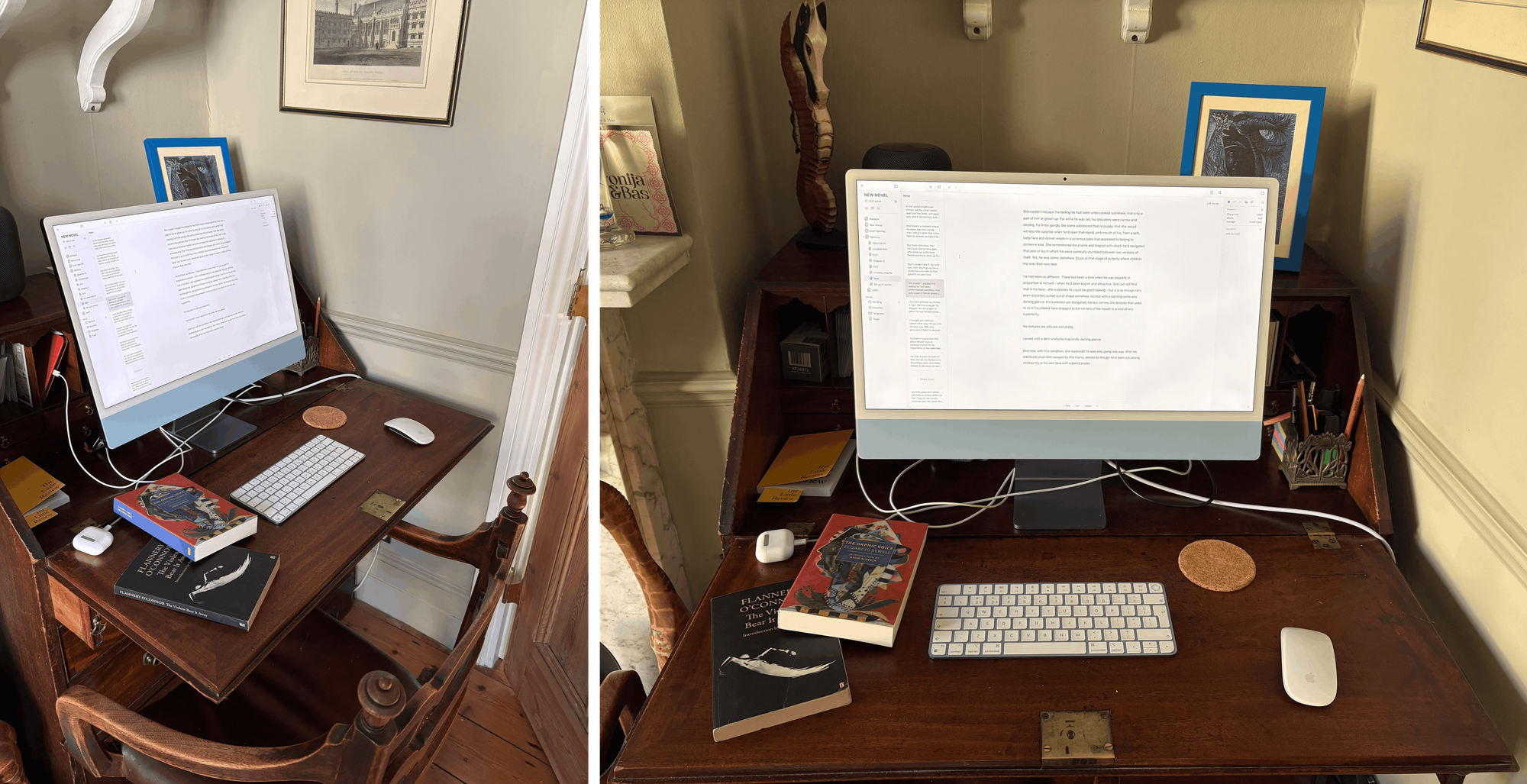
I like to write for a few hours at least each day, alongside reading. I think I work better in the mornings. For very early jottings I use iA Writer, as I like the fact it’s a blank page, and it feels ephemeral somehow. And then, once I feel like I’ve got something more substantive, with different bits, then I will transfer it to Ulysses and then keep on writing, maybe off the different spurs I’ve already got, while also rearranging them and adjusting. Only when I am relatively confident in the structure will I transfer to Word or similar and that is when I will work at home, at my desk, editing and redrafting. I also like to work from a physical page then too. So I use a notebook to ask questions of myself and to try and work things out and I will print out drafts and mark them up at home.
You’ve had the opportunity to teach writing. Have you noticed any common unproductive habits among aspiring writers? What essential learnings would you hope to pass on to writing students?
I’ve not taught enough to really comment—certainly not to have essential learnings for others. Also, I think people can have such different processes—what I’ve outlined above as working for me could be an anathema to someone else. But I feel fairly confident in saying that everyone needs to read to have an idea of how to write and to develop a sense of what it is they wish to write. And also, while it is important to give yourself the freedom to find your path and be creative, you do need some kind of routine. Or at least, to show up each day. Even if it’s unproductive, so long as you show up each day you will be there on the day it works. If you’re never in front of the page then you won’t be there for the good days. And I also know not to judge the ‘good’ days and the ‘bad’ days, because they often have swapped places when I look back with some distance on what I’ve done.
Your debut novel was named one of the best books of 2025 by The New Yorker. How have your life and writing opportunities changed since its publication?
It’s certainly opened up many doors and opportunities, particularly, actually, meeting other writers or critics I’ve long admired. That has been wonderful. There is also something scary—in a humbling way—about the book being out in the world and in others’ hands—it is no longer mine anymore, certainly not solely mine. And it is endlessly surprising and joyful meeting readers and to hear what they make of it. In that sense, it feels like a process that doesn’t end.
How do you plan to follow up The Boyhood of Cain? Would you like to share the projects you’re currently working on?
I’ve started work on a new novel. It was going great guns and then juddered to a halt. But it’s got going again. I have a character whom I love, but is perhaps inherently unlikable. Maybe that’s what I love him for. I’m still finding my way. But I have it open, here in Ulysses, with such promising titles as NEW NOVEL for the project and ‘Jumbled bits’ for a group. I’m excited, while anxious and despondent at the same time!
If you would like to read more about Michael, make sure to check out his website.