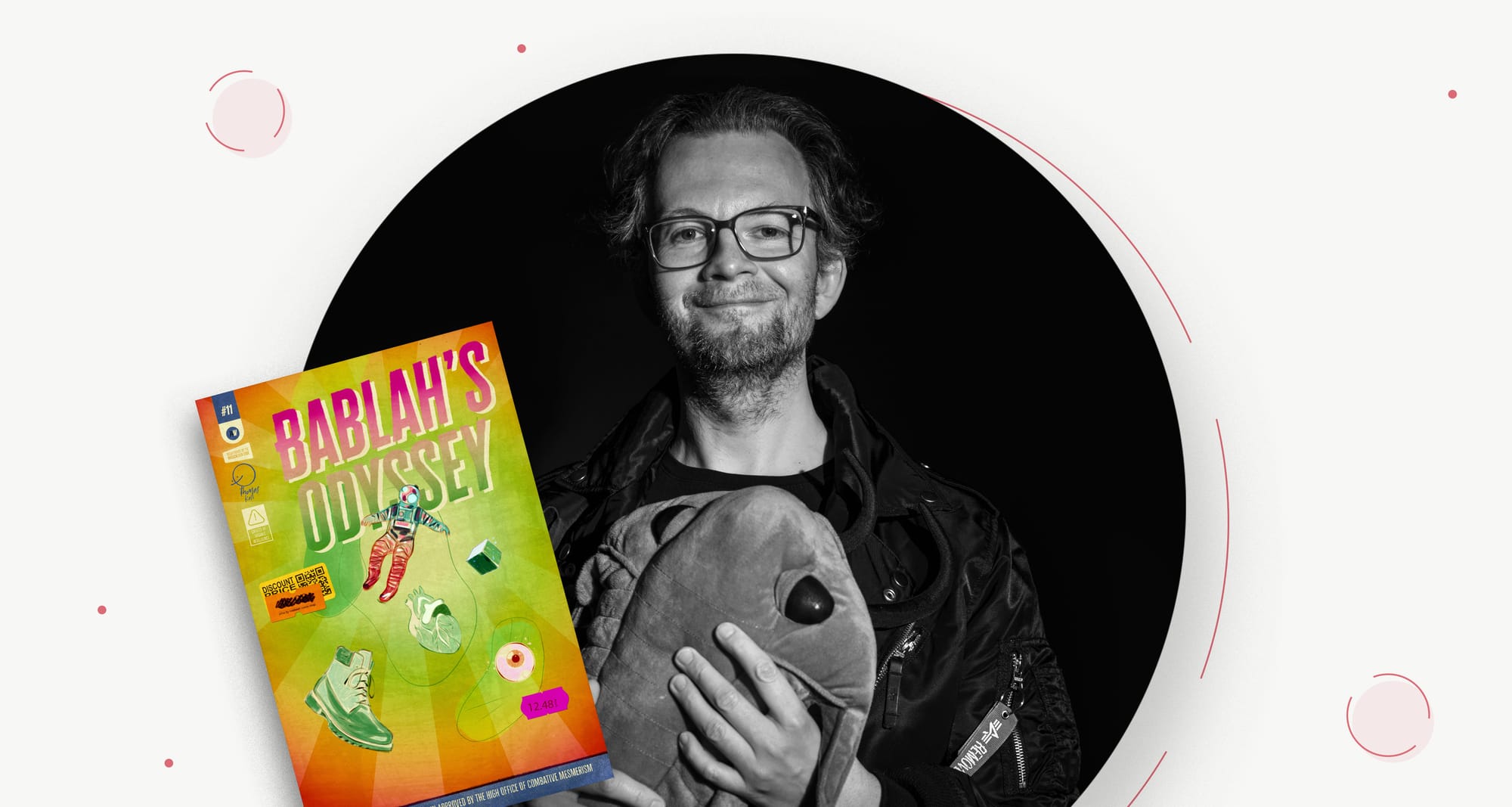
Thomas Kast is an award-winning independent illustrator and photojournalist from Zurich, Switzerland. Apart from holding a PhD in Fine Arts and teaching at multiple colleges, he is also the author of the philosophical sci-fi novel The Great Convergence and the comic series Bablah’s Odyssey. His website is thomaskast.com.
Let's start with your origin story. How did your interest in fine arts lead you to a career spanning illustration, art direction, and academic teaching?
Although it may not seem like it at first — all these specialities have a lot in common: delusional narcissism, an unquenchable thirst for dominance, and — most importantly — being deeply in love with the sound of one’s own voice.
What accelerates all of those, at least in my case, is perseverance. You see, like most people, artists fail in life. Unlike most people, artists don’t learn from their failures. I definitely didn’t. Add an acute case of ADHD and there you have it — me jumping all over the place.
You hold a PhD in Fine Arts. Was academia always part of the plan, or did it become clearer as you progressed through your studies?
Jokes aside, art school is quite a different environment from other universities. Although we studied many theoretical subjects — among others, art history, composition and the psychology of colour — most of the program was centered around practical skills: painting, drawing, composition, typography, etc. This provided a meaningful outlet for my chaotic and exceedingly contrarian nature.
I learned classical drawing techniques during the day at the academy, and real-life illustration at night in pubs and nightclubs, where I had become a local attraction of sorts. I’d just sit at the bar, or at some table in the corner, and keep drawing people on A4 sheets I always had with me. People would come and go, some of them I knew, some of them I didn’t. And I kept cranking out more and more drawings in exchange for free coffee — because I don’t drink anything else.
In time, apart from drawing people from life, I started adding random quotes from the conversations they had with one another to my sketches. Because these were taken out of context, the results were often hilarious.
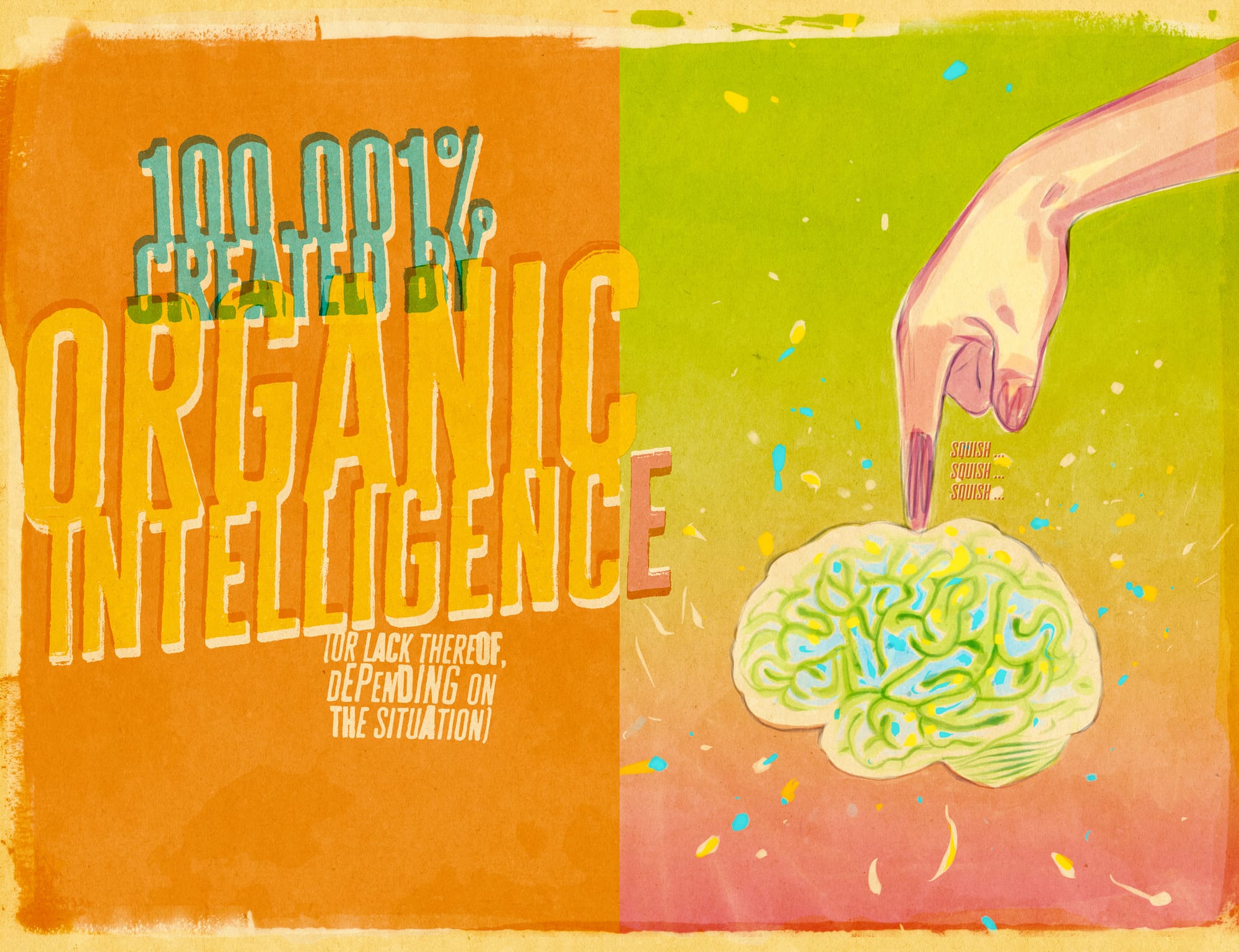
When people think about academia, they mostly have a more rigid structure in mind. In my experience, it was like being part of a larger, living and breathing organism. A place where you learn to combine theory with practice. Where you develop technical skills, but you’re encouraged to use what you learn to create your own unique artistic style and language.
So naturally, I was always drawn to academia as an institution created by people centred around a common idealistic goal. ETH is quite different in this regard, but that’s a story for another day, I guess.
You teach a course called “Design for Scientists” at ETH Zurich, after years of teaching illustration and photography at Shenkar in Tel Aviv. These are scientific and engineering-focused schools. How has teaching people outside the art world changed the way you think about your own visual language?
Shenkar offers a degree in visual communication, among many other things, and that’s what I was teaching. ETH, on the other hand, is strictly science- and engineering-oriented.
Teaching scientists requires a different approach and a very specific type of discipline. Being more analytical rather than intuitive on average, scientists and engineers approach aesthetic principles in a more meticulous way compared to art students. Scientists also use aesthetics to convey a specific message and increase information retention among their audience.
All of this didn’t change my own visual language, since that comes from the heart — a place traditionally off-limits to science.
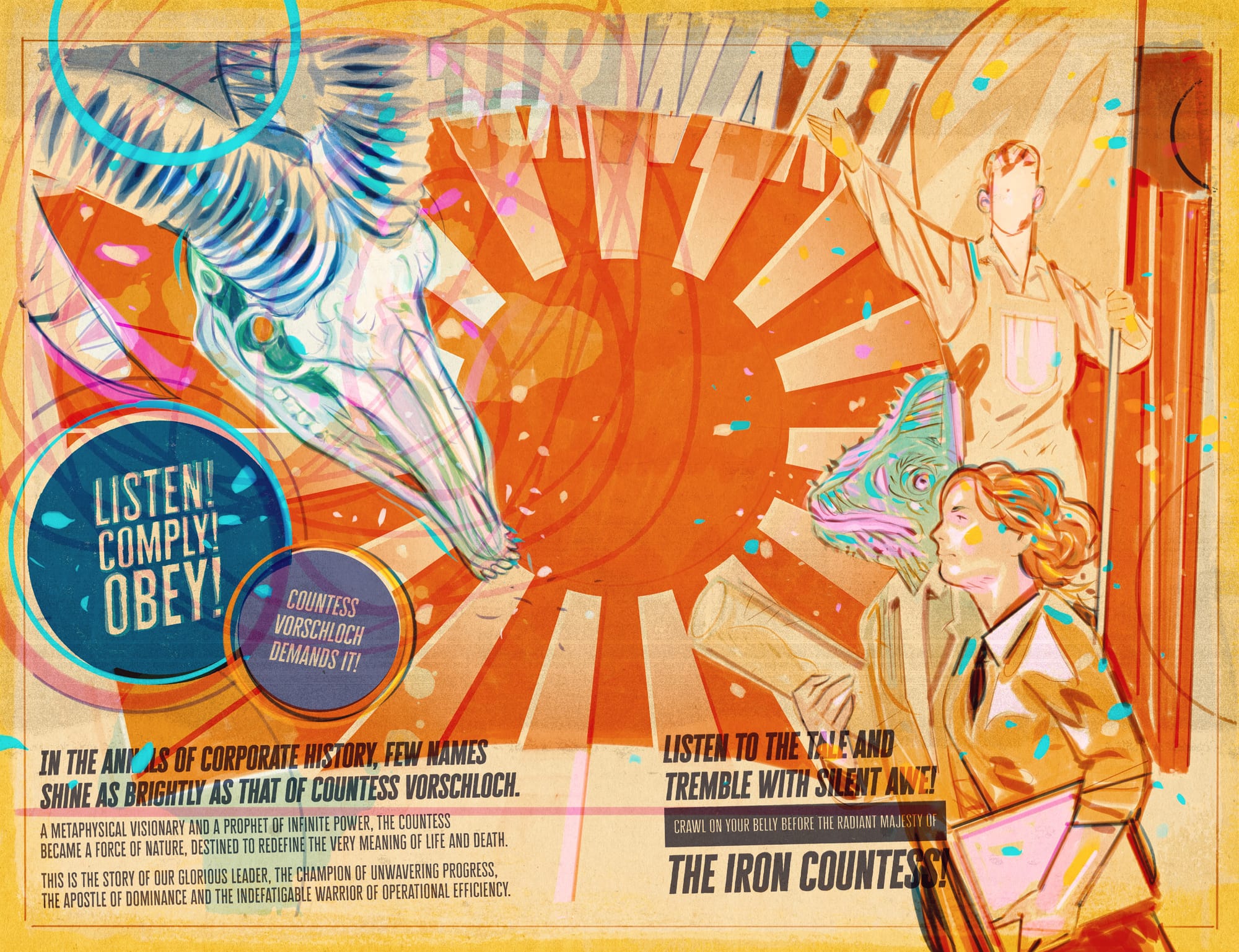
In terms of content, however, the world of science became an endless source of inspiration to me. The main protagonist in my comic series is a scientist, albeit an evil one. Another scientist, and the principal character in The Great Convergence, is an amalgamation of real-life scientists I know personally.
Because parts of my novel take place in a distant future, the science my characters use is more akin to magic. I’m not a fan of hard sci-fi, so I deal with general aspects of science, or its implications for humanity, in a much broader sense. That said, the scientific element remains quite dominant in my work.
My own visual language ... comes from the heart — a place traditionally off-limits to science.
You have a comic series called Bablah’s Odyssey, which we'll get into shortly, but you also have a novel, The Great Convergence. Both are philosophical science fiction works, and you described them as social satires. Can you share some more details about how your novel came together?
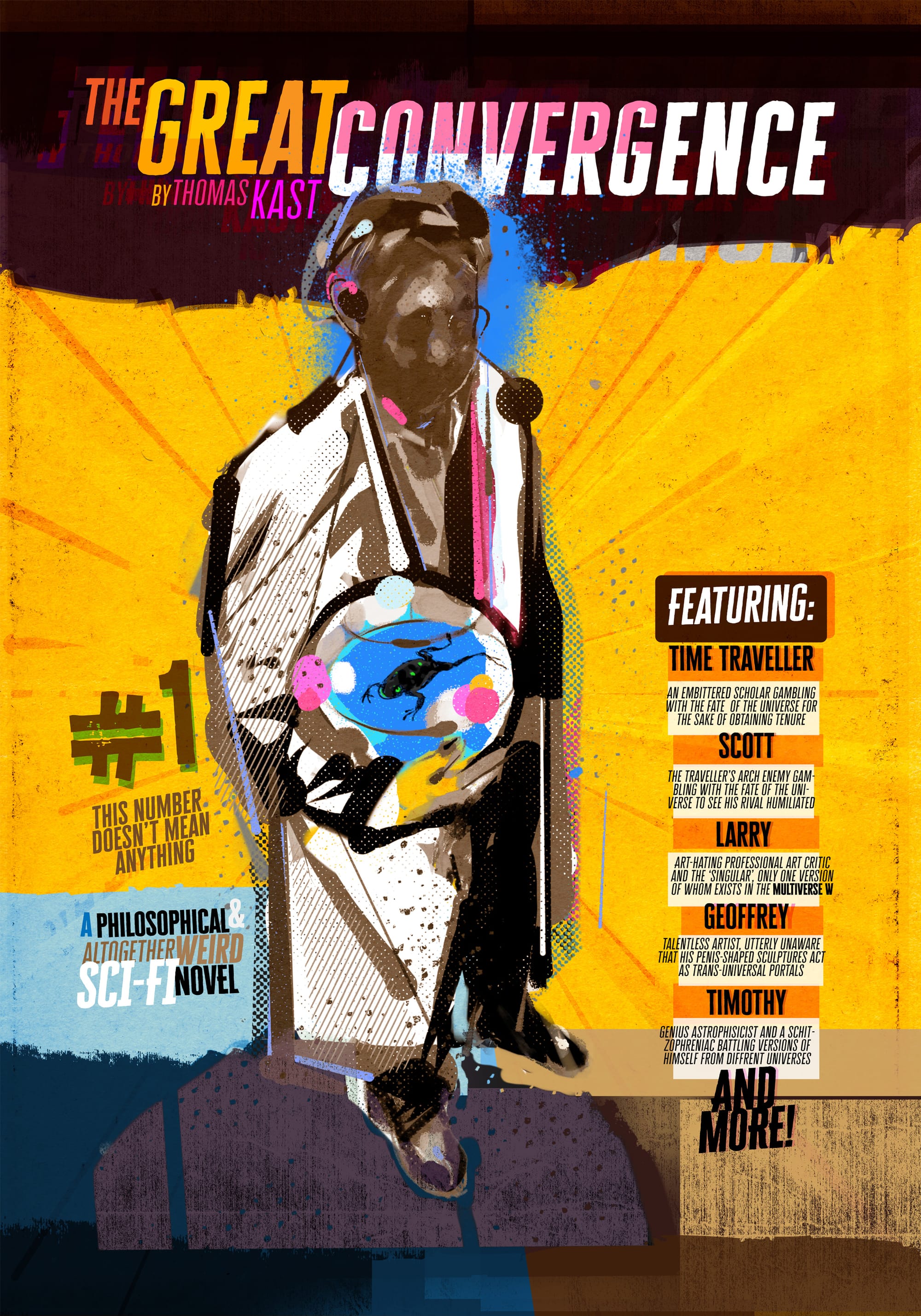
The Great Convergence combines my life’s greatest fascinations: art, science, philosophy, science fiction, and the mystery of human stupidity prevailing over common sense in every situation, at all times.
Having observed humanity for quite some time, especially the prosperous part of it, I had one and only one big dream: to be handsome and stupid. To my greatest disappointment, I turned out neither.
This transformed me into an exasperating nonconformist, hellbent on finding a hole in the whole from the moment I opened my eyes until the night would wrap the world in its ebony wings.
My constant complaining in front of everyone provided temporary relief from accumulated frustrations, but it can only get you so far. The alternatives were limited — alcohol, yelling at people in a park whilst standing on a tea box, or trolling others on various forums.
I couldn’t afford prolonged drinking. I’m socially awkward, so disseminating my views through a megaphone in a public space was also out of the question — I’ve neither the charisma nor the guts for that. Internet trolling wouldn’t work either, as it demands a lot of self-imposed discipline and firmness of purpose.
In the end, I opted for the cheapest and easiest route: writing novels and comics. And that’s what I’ve been doing ever since.
The Great Convergence draws on your own real-life experiences combined with what you call “unencumbered fantasies.” Where does the line sit between what actually happened to you and what you invented?
I’m not really sure, I have to admit. But does it really matter? Many of us spend time daydreaming about different worlds and realities. We often remember things not as they happened, but as we prefer them to be. We spend about a third of our lives sleeping, lingering in a dreamworld. And how do you even define objectivity if everyone’s experience is always subjective?
As for myself, I probably retain enough of a sense of reality not to jump off a building, flapping my hands and convinced that I can compete with birds for dominion over the sky. Save the extremes, I fully embrace spontaneous bouts of imagination blending with my moderately rational perception of the so-called reality thrust upon me from a young age, contrary to my desires.
Whenever my demons talk to me — I answer.
I think it’s important for artists and philosophers to speak up for those whose voices have been suppressed for too long. If we won’t do it, who else will?
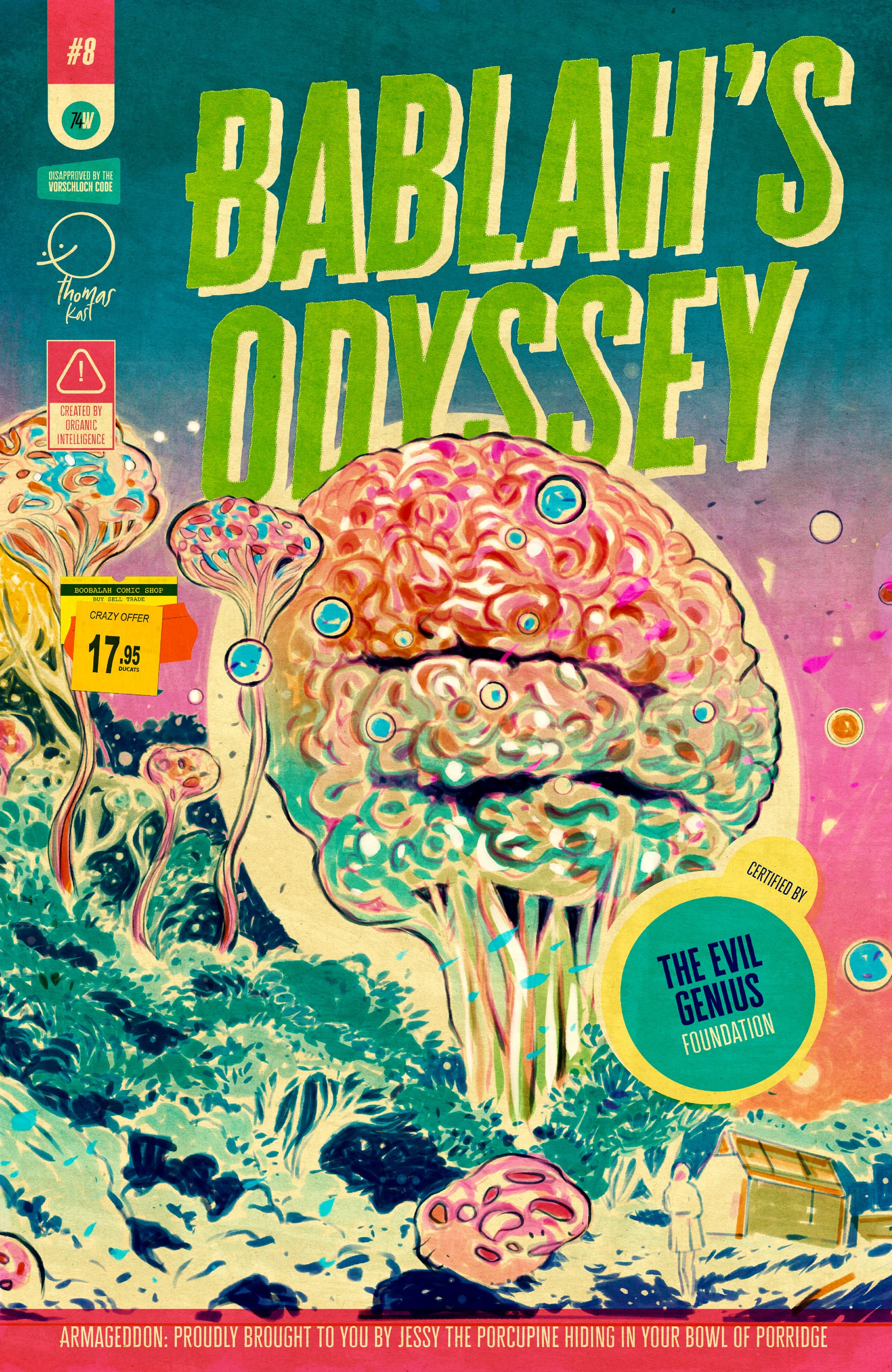
Your comic series, Bablah’s Odyssey, follows a journey across the universe where the protagonist teaches his partner about the “glory of civilisation”. Each part is a critique of modern society, especially capitalism, packed in a sci-fi setting. What drove you to tackle such heavy themes through a comic series?
A comic is a cross between a film and a book, roughly speaking. It’s accessible, yet it allows for incredibly wide-ranging expression, especially if you’re both the writer and the illustrator. Sometimes the imagery can enhance the written message. Sometimes what you see and what you read contradict each other, and an entirely different picture emerges.
Personally, I use imagery as an abstract representation of the story, which adds another layer of symbolism to it.
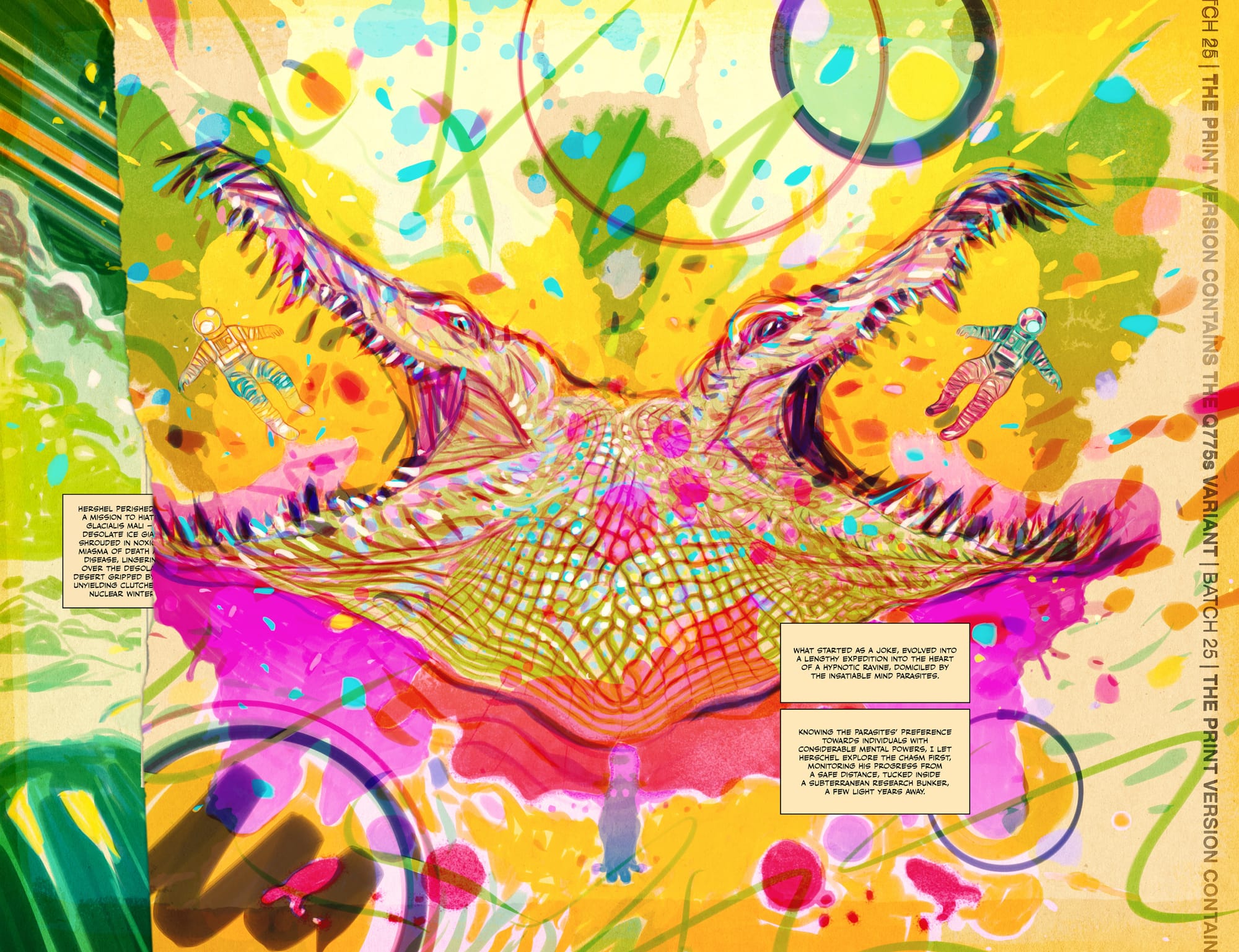
Regarding the rather sombre themes — once you look past the absurdist humour, I think it’s important for artists and philosophers to speak up for those whose voices have been suppressed for too long. If we won’t do it, who else will?
That said, even though I often depict the hopelessness of human lives as they drift aimlessly along the river of existence, crashing violently into one another, I actually view humanity with a lot of hope and sympathy. Ultimately, I want to help improve the social structure we created. And to accomplish that, I’m holding a mirror to the face of humanity, as the expression goes. To see is the first step towards overhauling the outdated system we live under.
If I could classify what I do, I’d call it surrealism with purpose ... but the underlying message is very much real, and it’s meant to penetrate deep into the reader’s soul.
The series also carries heavy elements of absurdity, moral introspection and self-reflection. Did you set out to explore those themes from the start, or was there a specific moment (a book, an experience) that pushed you in that direction?
It started with a brief conversation I had with an acquaintance of mine who works as a director at a bank. For reasons known only to him, he was telling me about a stakeholder meeting, at the end of which — he said — he suggested to his colleagues (and this is a direct quote): Let’s head downtown. I know a place full of those jobless people who play music and perform. It’s really cool.
Call it a final straw, which made me realise that we had created a world where social usefulness is inversely correlated with the rewards one receives for being useful to society.
As an artist and writer, I took it upon myself to reflect on humanity through my work. To ponder universal values — if there even is such a thing — to contemplate the essence of morality, and to call out wrongs for what they are. Having said that, I dislike spoon-feeding, moralising, or flattening complex issues. And that’s where absurd humour and metaphor come in.
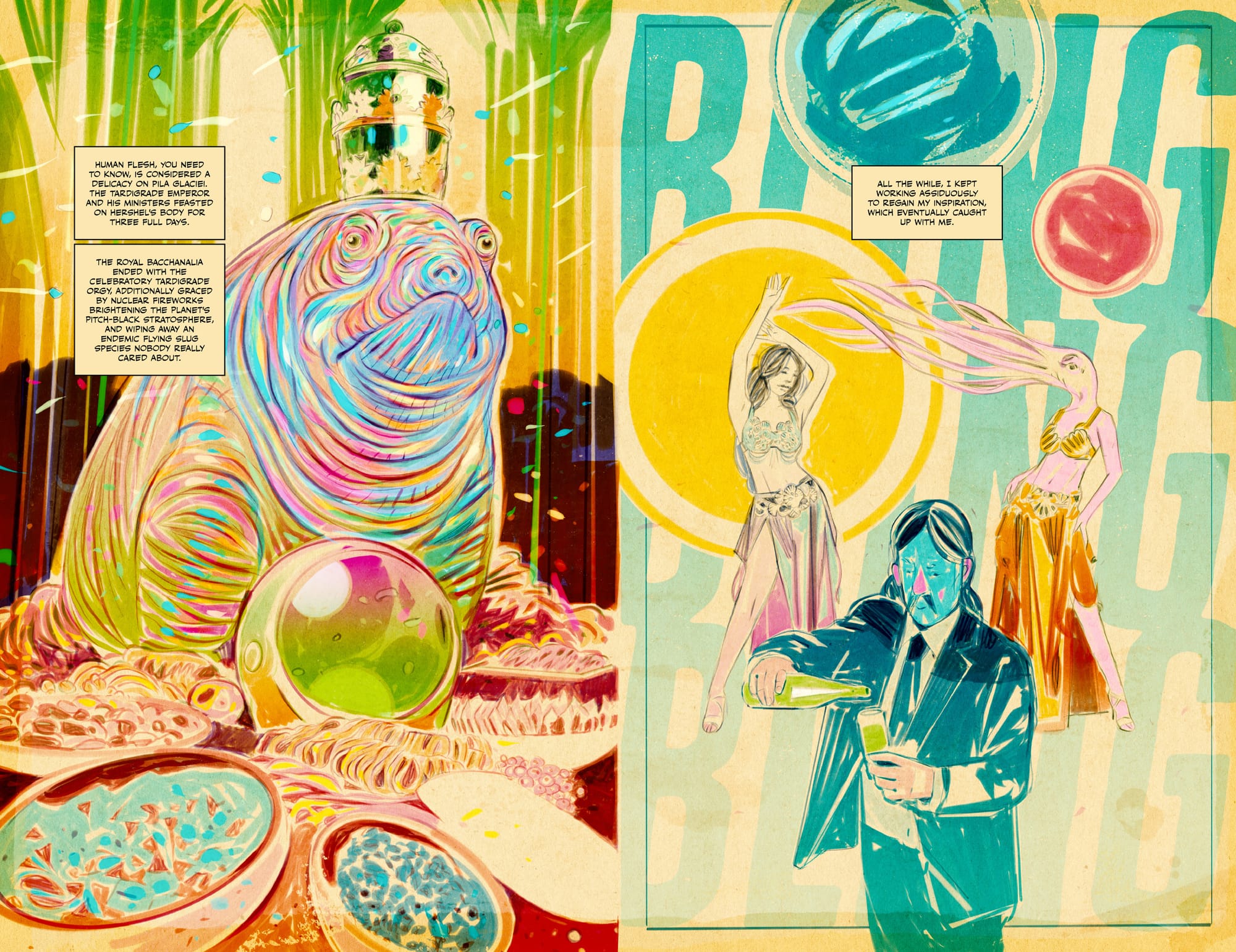
I frequently use symbolic language and depictions I’ve invented from scratch, and don’t shy away from avant-garde techniques to make the audience read between the lines and consider alternative interpretations. If I could classify what I do, I’d call it surrealism with purpose. The world-building, the psychedelic imagery and the expression remain uncanny — hallucinatory, even — but the underlying message is very much real, and it’s meant to penetrate deep into the reader’s soul.
Can you walk us through how a comic like this actually comes together? What does your process look like, what tools you use, and where does Ulysses fit into that workflow?
Everything starts with a topic I want to address. I choose it from the myriad of disjointed observations and unpolished notes that keep hatching in my head in impossible quantities. Once I settle on a specific issue, I sketch out a metaphorical representation of what I’m trying to say and map out the storyline.

From this point on, the process is intentionally chaotic — I create recurring digressions, analogies, and idiosyncratic symbolism. Ulysses material sheets are great for that purpose. Sketches and illustrations impact the writing, and vice versa. Finally, I combine everything into a more or less familiar structure for the reader. Rinse and repeat :)
I tried many writing tools in the past. Some of them I found downright horrible, like MS Word; others were unnecessarily complex, like Scrivener. Finally, I settled on Ulysses.
Ulysses is an incredibly powerful tool, and honestly, it would be very difficult — if not impossible — for me to keep everything under control without it.
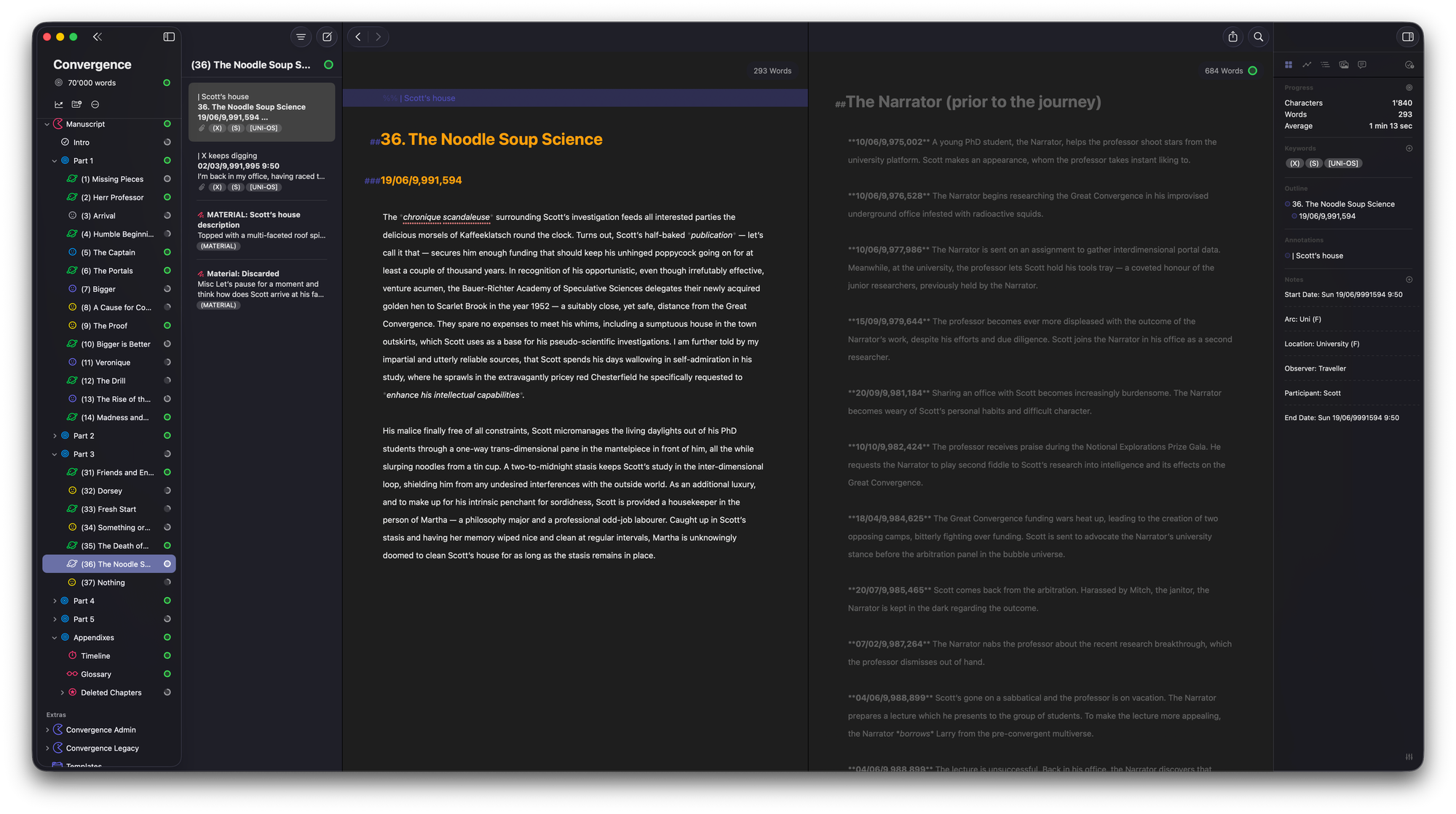
One of my favourite features is markup, which I use extensively and which makes writing so much quicker and easier, including the ability to instantly turn something into a clearly marked comment.
Another would be the highly polished interface, which allows for distraction-free writing but also supplies the user with an abundance of advanced and very useful options when you need them. I also find writing goals particularly handy. This setting allows me to keep the length of chapters and sections consistent.
Ulysses is built mainly for text-heavy writing, while a comic is obviously much more visual. What does your project structure inside the app look like for something like Bablah's Odyssey? Do you keep illustration scripts, notes, and finished text together, or deliberately apart?
I use different workflows for novel writing and scripts. For novels, the most useful Ulysses feature — for me, at least — is the integration with Aeon Timeline, which lets you keep track of your characters and chronology. This was especially important to me when writing The Great Convergence. The novel includes complex narration; different parts are written from the perspectives of various characters.
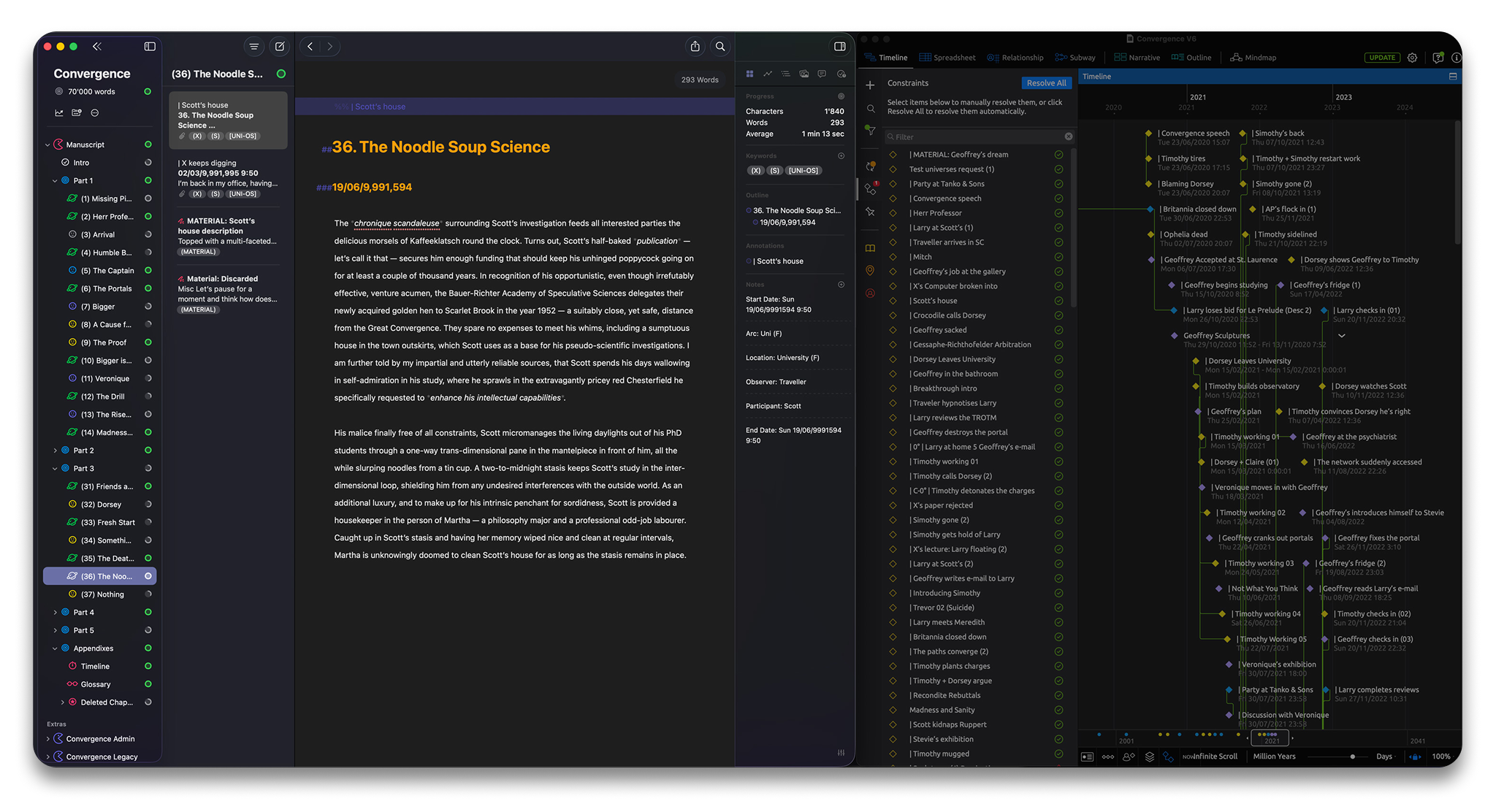
To add fuel to the fire, the events take place in different periods and locations. Because Ulysses integrates with Aeon so well, any changes made in Ulysses are reflected in the visual representation of a given timeline, and vice versa. The ability to use labels, scenes, a collapsible tree structure, and Ulysses’ organisational system was a lifesaver.
As for the comic series, it’s much more experimental than The Great Convergence. As I mentioned earlier, I like to use frequent asides, self-contained side stories, or ads for non-existent products and services. I like to use the surrealist collage technique, where a new meaning emerges from apparently disconnected passages or pages. With Ulysses, I can easily reshuffle everything without losing my sanity in the process — and yes, I constantly change my mind about everything.
Regarding the visual and contextual aspects of writing, I have both the text and the sketches in front of me at all times, and — as any ADHD-afflicted individual would — I switch between writing and drawing until I’m happy with the result.
Between photography, gallery work, art direction, writing a novel, producing a comic series, and teaching at universities—what's next for you? Is there another project, medium, or idea you haven't attempted yet that you're circling?
Together with a friend of mine, who’s an ex-Google engineer, we’re actively working on a manuscript-exchange startup called Lizard Joe. In essence, Lizard Joe helps writers refine and finalise their work before publishing or pitching it to a literary agent. The platform will be free to all users, without any catch and without siphoning off and reselling personal data.
Finding relevant beta readers can be hard. I remember searching for mine on various platforms, like Fiverr, but the process was really painful. Because Lizard Joe is optimised for finding the most appropriate readers across many genres, we aim to make reader-writer matching easy and intuitive.
The existing solutions on the market lean heavily into the editing aspect, which is less relevant during the beta stage.
Another problem Lizard Joe solves is that many writers don’t know how to work with beta readers, which results in a lot of back-and-forth. For that reason, we standardised the feedback procedure. We’ll also — with users’ permission — pitch the most-liked manuscripts to publishers and literary agents.
That’s it in a nutshell. If everything goes well, we expect the platform to debut in early 2027.
If you would like to read more about Thomas, make sure to check out his website.